Every year, millions of Medicare beneficiaries overpay for their prescription medications — not because they made bad choices, but because Medicare Part D is genuinely confusing.
Coverage gaps. Formularies. Tier levels. Premium vs. cost-sharing tradeoffs. It's a lot. And when you're managing your health and your budget in retirement, that confusion costs real money.
This week, we're breaking down Medicare Part D in plain English — what it covers, how it works, what the major 2025–2026 changes mean for your wallet, and how to choose a plan that actually fits you.
What Is Medicare Part D?
Medicare Part D is the prescription drug coverage component of Medicare. It's sold through private insurance companies approved by Medicare, and while it's technically optional, most beneficiaries should have it.
Here's why: if you don't enroll when you're first eligible and don't have other creditable drug coverage, you'll face a late enrollment penalty — 1% of the national base beneficiary premium for every month you went without coverage. That penalty is permanent.
Two Ways to Get Part D
- Standalone Part D Plan (PDP): Added on top of Original Medicare (Parts A & B). You keep your Medicare and add a drug plan from a private insurer.
- Medicare Advantage with Drug Coverage (MAPD): Most Medicare Advantage plans include built-in prescription drug coverage. One plan, one card.
The 2025–2026 Changes You Need to Know
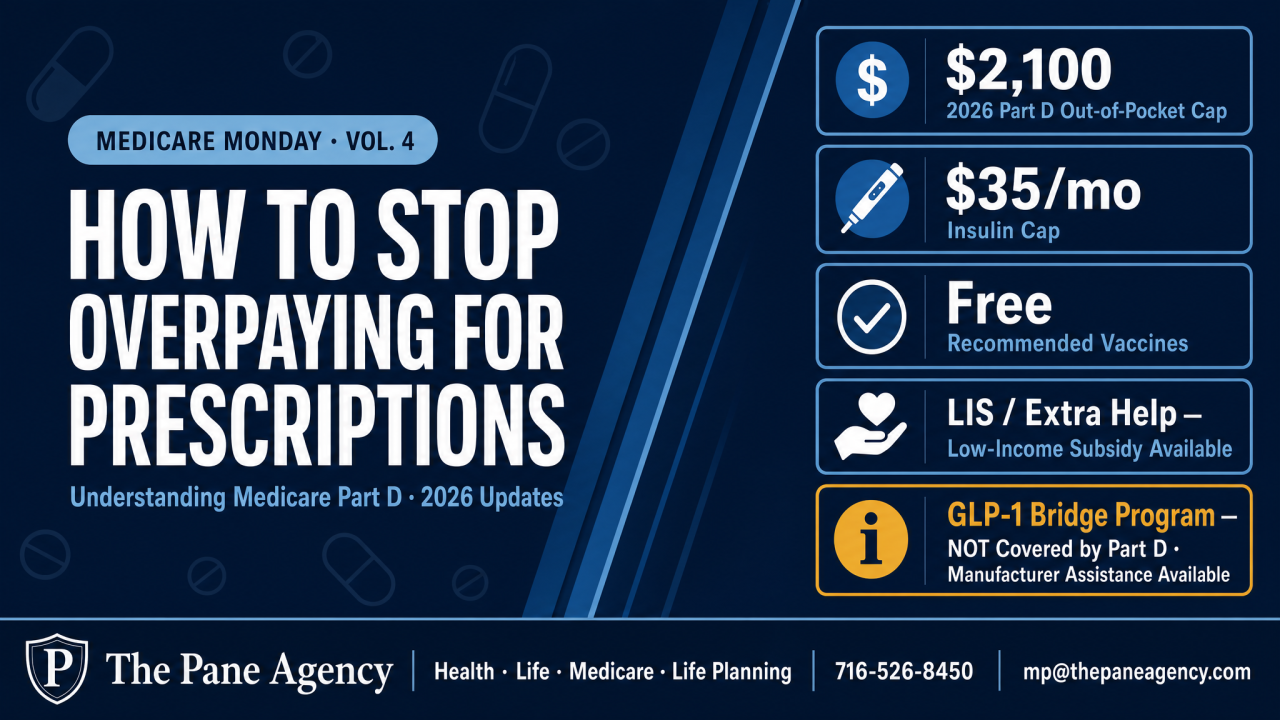
- $2,100 Out-of-Pocket Cap (2026). For 2026, Medicare Part D caps your total annual out-of-pocket drug costs at $2,100 — indexed upward from the $2,000 cap introduced in 2025 under the Inflation Reduction Act. Before this change, there was no hard annual cap on Part D drug costs. For anyone on expensive specialty medications, this ceiling provides real, meaningful protection year over year.
- Medicare Prescription Payment Plan. A voluntary option to spread your drug costs across monthly installments throughout the year rather than paying large amounts all at once. Great for cash-flow management.
- $35/Month Insulin Cap. Insulin is capped at $35/month for all Medicare Part D enrollees, regardless of plan.
- Recommended Vaccines at No Cost. Shingles, flu, pneumonia, and COVID vaccines are covered at no cost under Part D. Don't leave these on the table.
How to Choose the Right Part D Plan
Most people go wrong immediately: they pick the plan with the lowest monthly premium. But the lowest premium plan often has higher copays, stricter tier restrictions, and a narrower formulary.
My 5-Step Framework
- Step 1 — Make Your Medication List. Write down every prescription: name, dosage, frequency. This is your starting point.
- Step 2 — Check the Formulary. Every Part D plan has a formulary — a list of covered drugs organized into tiers. Lower tiers = lower copays. Verify your medications are covered and at what tier.
- Step 3 — Understand the Deductible. Many plans carry an annual deductible (up to $590 in 2025) before coverage kicks in. Some waive it for lower-tier drugs.
- Step 4 — Add It All Up. Monthly premium × 12 + deductible + estimated drug copays = true annual cost. The lowest-premium plan is rarely the cheapest plan overall.
- Step 5 — Check Your Pharmacy. Preferred pharmacy networks matter significantly. Some plans offer substantially lower copays at preferred pharmacies and mail-order programs.
Low-Income Subsidy (LIS) / Extra Help — Are You Leaving This on the Table?
The Extra Help program — formally called the Low-Income Subsidy (LIS) — is one of the most valuable and most underutilized programs in all of Medicare. If you qualify, it can dramatically reduce or virtually eliminate your Part D costs.
What Extra Help covers:
- Monthly Part D premium (partially or fully)
- Annual deductible
- Copays and coinsurance for covered prescriptions
2026 Eligibility at a Glance
| Benefit Level | Income Limit (Single) | Income Limit (Married Couple) |
|---|---|---|
| Full Extra Help | Up to 135% FPL ($20,780/yr) | Up to ~$28,150/yr |
| Partial Extra Help | Up to 150% FPL ($23,090/yr) | Up to ~$31,260/yr |
Note: Resource limits also apply — generally under $16,660 (single) / $33,240 (couple) in countable assets, not including your home, one car, or life insurance.
Who is automatically enrolled: If you receive full Medicaid, Supplemental Security Income (SSI), or are enrolled in a Medicare Savings Program (MSP), you are automatically enrolled in Extra Help — you do not need to apply separately.
If you're not auto-enrolled, apply through:
- Social Security Administration: SSA.gov or 1-800-772-1213
- Your state Medicaid office
- An agent with The Pane Agency — free, unbiased help
Why this matters more than ever in 2026: even with the new $2,100 annual out-of-pocket cap, someone on multiple specialty medications could still face $2,100 in annual Part D costs. Extra Help can reduce those copays to as little as a few dollars per prescription.
Source: SSA Extra Help Program Guidelines, 2026; CMS LIS Fact Sheet, 2025
5 Common Part D Mistakes
- Auto-renewing without reviewing. Plans change every year — formularies shift, premiums change, drugs move between tiers. Open Enrollment (October 15–December 7) is your annual opportunity to compare. Use it.
- Not using Medicare's Plan Finder. Medicare.gov/plan-compare lets you enter your medications and compare real annual costs side-by-side. It's excellent and underused.
- Ignoring mail-order. Many plans offer 90-day supplies via mail order at a lower cost per fill than monthly retail. If you're on stable maintenance medications, this saves real money.
- Missing Extra Help. The federal Low-Income Subsidy (LIS) program helps people with limited income pay Part D costs. Eligibility is broader than many realize.
- Overlooking an Original Medicare + Medigap + PDP combination. For some beneficiaries, this structure provides better overall coverage and lower out-of-pocket costs than Medicare Advantage. It's worth running the comparison.
GLP-1 Bridge Program — A Game-Changer for Beneficiaries Managing Obesity
This may be the biggest prescription drug news of 2026.
For the first time, CMS announced a program regarding GLP-1 anti-obesity medications — Wegovy (semaglutide) and Zepbound (tirzepatide) — for those who have obesity but do not have Type 2 diabetes. Previously, Medicare only covered GLP-1 receptor agonists (like Ozempic and Mounjaro) when prescribed specifically for diabetes management.
What changed: CMS finalized coverage of FDA-approved anti-obesity medications (AOMs), effective July 2026. This followed years of advocacy and a formal regulatory change addressing an outdated exclusion that had blocked coverage of weight-management medications since Medicare's inception.
Who qualifies:
- BMI ≥ 30 (obesity), OR
- BMI ≥ 27 with at least one weight-related condition (hypertension, dyslipidemia, obstructive sleep apnea, cardiovascular disease, or type 2 diabetes)
The GLP-1 Bridge Program: Recognizing that coverage phasing in takes time — and that formulary placements, prior authorization timelines, and plan-level coverage vary — both CMS and the major GLP-1 manufacturers (Novo Nordisk and Eli Lilly) have announced bridge assistance programs designed to help Medicare beneficiaries access these medications affordably during the transition period while full Part D integration is finalized across all plans.
Key details of the bridge:
- Manufacturer co-pay assistance cards (subject to income and eligibility requirements)
- Copay of $50 per fill
- Patient assistance programs for beneficiaries below income thresholds
- CMS guidance directing plans to implement AOM coverage without undue prior authorization barriers
- Help beneficiaries navigate formulary placement and coverage appeals
Why this matters for the 55+ population: Obesity is a significant driver of cardiovascular disease, hypertension, joint disease, sleep apnea, and type 2 diabetes — all conditions disproportionately affecting beneficiaries. Access to clinically effective medications at manageable cost is a meaningful quality-of-life and longevity issue for this population.
The cost reality under 2026 Part D: Some GLP-1 medications are Preferred Brand drugs. Even with Part D coverage, your cost-sharing will depend on your specific plan's formulary placement and tier structure. The good news: some GLP-1 costs now count toward your $2,100 annual out-of-pocket cap, providing a ceiling on your total exposure.
If you or a family member is interested in GLP-1 coverage under your current plan, or wants help evaluating which plans offer the best formulary placement for these medications — that's exactly the kind of review I'm happy to walk through with you.
Sources: CMS Final Rule on Anti-Obesity Medications, 2025; Novo Nordisk Patient Assistance Program; Eli Lilly / Lilly Cares Foundation; CMS Part D Coverage Guidelines, 2026
The Bottom Line
Medicare Part D is one of the most review-worthy decisions you'll make as a Medicare beneficiary — and the good news is that you're not locked in forever. Every Open Enrollment is a fresh start.
If you're not sure whether your current plan is still the right fit, or if your medications have changed in the past year, reach out. I'm happy to walk through your options with no pressure and no cost.
This article is for general education only and is not plan-specific advice. Costs, caps, and coverage rules are set annually by CMS and can change. For official information visit Medicare.gov or call 1-800-MEDICARE.